
He looked up sharply.
I held his gaze.
“And I know your relationship with Caroline wasn’t strictly professional.”
His face drained of color.
For several seconds, neither of us spoke.
Finally, he whispered, “It ended months ago.”
I felt something inside me go quiet.
Not because his confession didn’t hurt, but because I’d already spent two days watching every explanation he offered collapse under the weight of the next document.
“How long?” I asked.
“About six months.”
“And the financial problems?”
He hesitated.
“They started before that.”
I shook my head.
“So while you were criticizing me for buying groceries, you were hiding debts and seeing another woman?”
Daniel stepped closer.
“I made mistakes, Rachel. But I was trying to protect our family.”
I moved away from him.
“Protect us from what? The truth?”
He didn’t answer.
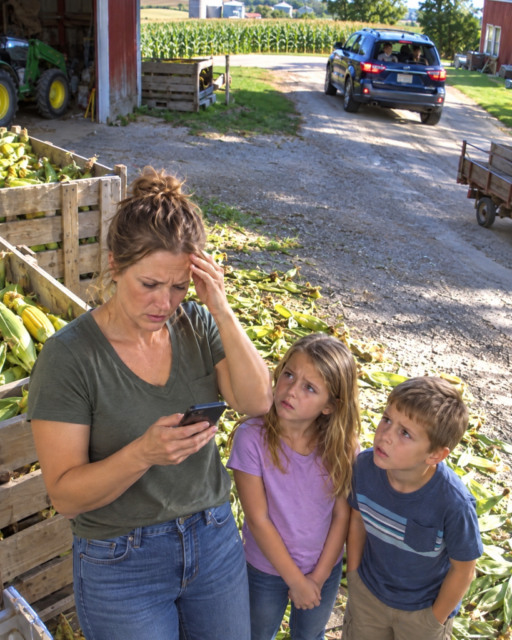
I thought about Sophie and Noah working beside me in the cornfields. I remembered Daniel laughing before his vacation, telling me hard work would be good for me.
He’d spoken as though I was the irresponsible one.
Now I understood how much energy he’d spent making sure I never questioned his decisions.
“I’m not coming home tonight,” I told him.
His head snapped up.
“Rachel, don’t do this.”
“I need time to understand what you’ve done to our finances. And I need space to decide what happens to our marriage.”
He looked toward the farmhouse.
“What about the kids?”
“They’re safe with me. We can discuss arrangements calmly, but you don’t get to use them to end this conversation.”
Daniel’s expression hardened.
“You’re really going to throw away fourteen years?”
I looked at him.
“I didn’t create this situation.”
He stood there for another moment, apparently waiting for me to soften.
I didn’t.
Eventually, he walked back to his SUV.
Before leaving, he turned toward me.
“You don’t know everything Caroline did either.”
I folded my arms.
“Then you should have told me the truth before she had to.”
He drove away without answering.
That evening, Patricia called.
Her voice sounded strained.
“Rachel, I’ve been going through my bank records. I found something I think you need to know.”
My stomach tightened.
“What did you find?”
“Daniel didn’t just ask me to reimburse the credit-card charges. Last winter, he borrowed money directly from me.”
I closed my eyes.
“How much?”
“Twenty-five thousand dollars.”
I gripped the edge of the kitchen counter.
“Patricia, why didn’t you tell me?”
“He said it was for an emergency involving the business. He promised he’d repay me before you noticed anything was wrong.”
I felt sick.
Daniel had been borrowing money from his mother while secretly accumulating charges on my account and making payments under a settlement agreement.
“Did he pay you back?”
“No.”
Patricia hesitated.
“Rachel, there’s something else. When I asked him about the money this morning, he told me he’d already arranged to refinance your house.”
I stopped breathing.
“Our house?”
“Yes. He said the paperwork was almost finished.”
I looked toward the window.
Our home was the one thing I’d believed was financially secure. We’d spent years making mortgage payments, and Daniel had repeatedly assured me that we were finally approaching the point where we could live without worrying about major debts.
“Did he say how much he wanted to borrow?” I whispered.
Patricia’s voice trembled.
“Eighty thousand dollars.”
I sank into a chair.
The credit-card charges were no longer the only problem.
Daniel had been hiding obligations that could threaten the home our children depended on.
Then Patricia said something that made me sit upright.
“Rachel, he told me you’d already agreed to the refinancing.”
I stared at the wall.
“I never agreed to anything.”
There was a long silence.
Finally, Patricia whispered, “Then whose signature is on the application?”
I opened my laptop and searched our email records for the lender’s name she’d given me.
A few minutes later, I found a document notification that had been routed to an old email address Daniel sometimes used for household paperwork.
The attached application listed both of us as borrowers.
And beside my name was an electronic signature I had never authorized.
Daniel hadn’t simply hidden debt from me. Someone had submitted paperwork that made it appear I’d agreed to put our family home at risk.
The electronic signature beside my name looked almost convincing. My full name appeared beneath the refinancing application, followed by a date and a confirmation number, but I knew I had never agreed to borrow $80,000 against our family home.
I sat at my parents’ kitchen table, staring at the document while my mother quietly put the children to bed upstairs. For fourteen years, I’d trusted Daniel with our marriage, our finances, and the home we’d worked so hard to afford.
Now I was looking at paperwork that made it appear I’d authorized a debt I knew nothing about.
The following morning, I called my attorney, Victoria Hayes, and forwarded her the application. She immediately advised me to contact the lender, dispute the authorization, and request that the application be placed on hold while its authenticity was investigated.
I followed her instructions and spoke with a representative from the lender’s fraud department.
“Mrs. Bennett, are you saying you did not authorize this application?” the representative asked.
“That’s correct. I didn’t sign it, and I didn’t know it existed.”
She confirmed that the application had not yet resulted in a funded loan and explained that the lender would review the electronic-signature records.
I felt a wave of relief.
Our house wasn’t safe simply because I’d discovered the application, but at least I had found it before the money was released.
That afternoon, Victoria met me at her office.
We reviewed the credit-card statements, Patricia’s reimbursement records, the settlement documents involving Caroline Whitmore, and the refinancing application.
The figures were staggering.
Daniel had concealed $18,731 in additional credit-card charges before his vacation, a $62,000 settlement obligation, and a separate $25,000 loan from his mother. Some payments and obligations might overlap, so we couldn’t simply add everything together and call it his total debt.
But the pattern was undeniable.
He’d hidden major financial decisions while repeatedly telling me that our family needed to spend less.
Victoria explained that we needed to establish which debts were legally mine, which were Daniel’s, and whether any signatures or account authorizations had been improperly obtained.
Then she asked a question that made me pause.
“Rachel, do you want to remain married to him?”
I looked down at my wedding ring.
For days, I’d been so focused on protecting our finances that I hadn’t allowed myself to consider what I wanted emotionally.
“I don’t know whether I can ever trust him again,” I admitted.
Victoria nodded.
“You don’t have to decide everything today. But you can begin protecting yourself and your children now.”
I left her office with a clearer plan.
I would maintain the restrictions on the additional credit cards, cooperate with the account investigations, and preserve copies of every relevant document. Victoria would help me understand my options for separation and financial protection.
For the first time since Daniel’s vacation, I felt as though I was making decisions based on facts rather than his explanations.
That evening, Patricia came to my parents’ farmhouse.
She carried a folder containing bank statements, copies of her transfers to Daniel, and the paperwork she’d found relating to his debts.
“I should have asked more questions,” she said quietly.
I shook my head.
“He told both of us different stories.”
Patricia looked toward the living room, where Sophie and Noah were watching television.
“I don’t want my grandchildren to lose their home because my son refused to tell the truth.”
Her voice broke slightly.
“I love Daniel, Rachel. But loving him doesn’t mean pretending he hasn’t done something terribly wrong.”
For years, Patricia and I had disagreed about everything from holiday plans to how much television the children should watch. I never imagined she would become one of the people helping me understand what her son had hidden.
Two days later, Daniel asked to meet.
I agreed, but only at Victoria’s office.
He arrived looking exhausted, carrying a folder of documents and wearing the same anxious expression I’d seen in the farmyard.
“I want to fix this,” he said immediately.
Victoria gestured toward the chair across from us.
“Then we need complete and accurate information.”
Daniel opened his folder.
He admitted that he’d concealed the settlement with Caroline, borrowed money from Patricia, and allowed the additional credit cards to remain active without telling me.
When Victoria asked about the refinancing application, he looked down.
“I thought I could use the money to consolidate everything before Rachel found out.”
I stared at him.
“You thought borrowing another eighty thousand dollars would solve the problem?”
“I was trying to keep us from losing everything.”
“By risking our house?”
He didn’t answer.
Victoria asked whether he’d submitted the application using my information.
Daniel hesitated before admitting that he’d initiated it and allowed the electronic authorization to proceed without discussing it with me.
The lender would still need to investigate the signature and authorization records, but hearing him acknowledge what he’d done was devastating.
For months, he’d treated me as though I couldn’t be trusted to manage grocery expenses.
Meanwhile, he’d been making decisions that could have affected our entire family’s future.
Daniel leaned toward me.
“Rachel, I know I’ve hurt you. But we can work through this.”
I looked at the man I’d married.
I remembered our wedding, the births of our children, and the countless ordinary evenings we’d spent together.
Those memories were real.
But so were the lies.
“I spent fourteen years believing we were partners,” I said. “You made financial decisions behind my back, hid a relationship with another woman, and then blamed me for spending money on our children.”
His eyes filled with tears.
“I made terrible mistakes.”
“Yes,” I replied. “And now you have to accept that apologizing doesn’t erase them.”
I told him I intended to pursue a legal separation while the financial matters were investigated.
He lowered his head.
For once, he didn’t argue.
Over the following months, the process was difficult but necessary. The lender closed the unfunded refinancing application after reviewing my dispute, and the credit-card issuer investigated how the additional users had been authorized.
Patricia and Melissa provided their records, helping establish which purchases they’d made and what Daniel had told them about the account.
Through our attorneys, we began separating our finances and addressing the outstanding obligations. Daniel also had to deal with the consequences of his own agreements and the questions surrounding his expense claims.
None of it happened overnight.
There were uncomfortable conversations, legal expenses, and evenings when I worried about what the future would look like.
But Sophie and Noah remained surrounded by people who loved them.
My parents helped with school pickups, Patricia continued visiting the children, and I returned to work with a renewed determination to create a stable home.
One afternoon, several months after the confrontation, I found myself back in my parents’ cornfield.
The harvest season was ending, and Sophie and Noah were helping my father load the final crates into his pickup.
My mother brought lemonade onto the porch, and the children laughed as they argued about who had worked harder.
I stood beside the truck, watching them.
Then I remembered Daniel’s words before he left for that vacation.
“A little hard work will be good for you.”
At the time, he’d meant the harvest.
He’d imagined himself relaxing at an expensive resort while I spent my days working in the summer heat.
But the hardest work hadn’t involved corn.
It had been examining the accounts I’d trusted him to manage, confronting truths I never wanted to discover, and making decisions that frightened me because I could no longer rely on the marriage I’d believed was secure.
My father approached and handed me a bottle of cold water.
“You doing all right, sweetheart?”
I looked toward the children.
“Better than I was.”
He smiled.
“Good.”
That evening, after we finished working, Sophie climbed into the passenger seat of my car.
“Mom, are we coming back next summer?”
I smiled.
“Of course.”
She looked relieved.
“Good. Grandpa says I’m getting really fast at picking corn.”
Noah leaned forward from the back seat.
“I’m faster.”
They began arguing playfully, and I laughed for the first time that day.
Driving home, I realized how much my understanding of responsibility had changed.
Daniel had spent nearly a year insisting that responsibility meant sacrificing ordinary comforts while he quietly created debts and obligations I knew nothing about.
I’d believed that being a good wife meant trusting his judgment, even when his decisions didn’t make sense.
Now I understood that trust required honesty, and a partnership couldn’t survive when only one person was allowed to know the truth.
I didn’t know exactly what my life would look like a year later.
The legal process was still ongoing, and there were difficult choices ahead.
But I knew something I hadn’t known when Daniel drove away for that vacation.
I could protect my children, manage my own finances, and make decisions without waiting for his permission.
That night, after Sophie and Noah were asleep, I sat at the kitchen table and reviewed our household budget.
The numbers weren’t perfect.
There were expenses to manage and plans to reconsider.
But every figure on the page was one I understood.
No hidden cards.
No unexplained transfers.
No promises that everything would somehow work out if I simply stopped asking questions.
I closed my laptop and looked around the quiet house.
For the first time in months, I wasn’t frightened of opening another statement.
My husband thought leaving me in a cornfield would teach me the value of hard work. Instead, it taught me that the most important thing I could harvest was the truth—and that I no longer had to pay the price for someone else’s lies.