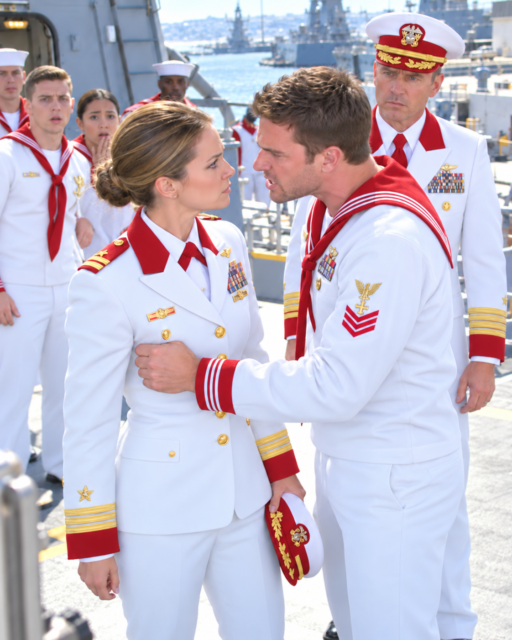
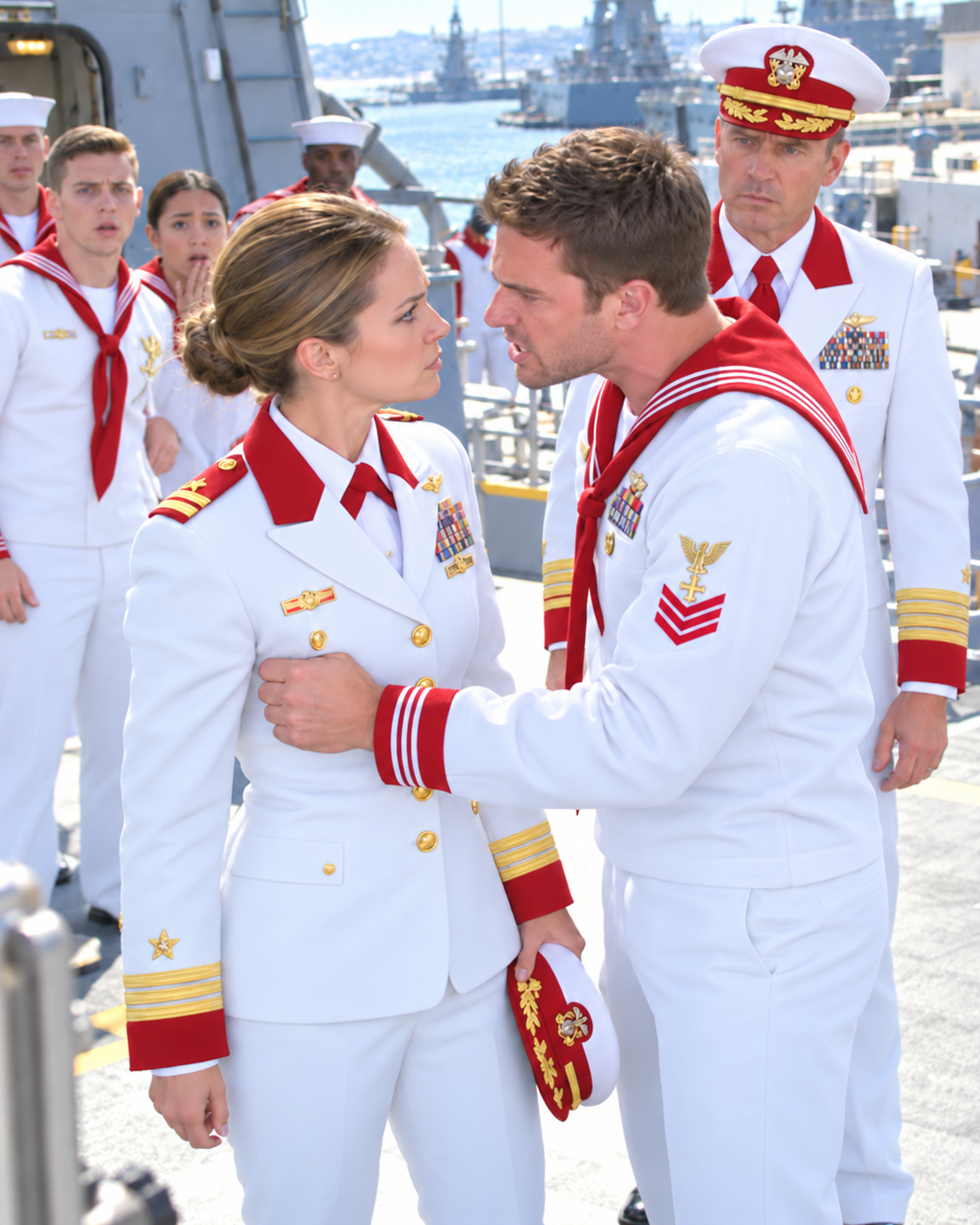

My younger brother grabbed my uniform in front of a dozen sailors and laughed.
“Still pretending you’re important, Sandra?”
His fingers tightened around my sleeve, directly beneath the two silver stars on my shoulder boards.
“Dad was right. You really think those decorations make you better than the rest of us.”
Several sailors laughed nervously. One looked away, clearly uncomfortable, but nobody intervened.
I stood at the bottom of the gangway leading to the USS Sterett at Naval Base San Diego, watching my brother enjoy the attention.
“Remove your hand, Petty Officer,” I said.
Brandon grinned.
“Or what? You’re going to tell Dad?”
He had no idea why I was there.
And he certainly didn’t know that, less than an hour earlier, my attorney had called about a suspicious transaction involving a property worth $3.2 million.
A transaction bearing my signature.
A signature I had never written.
My name is Sandra Owens. I’m fifty-two years old, a rear admiral in the United States Navy, and the daughter of a retired Army Sergeant Major who spent most of my life making me feel like the disappointing child.
My father, Thomas Owens, had served for thirty years. He believed discipline, sacrifice, and loyalty were the foundations of a respectable family.
At least, that was what he taught everyone outside our home.
Inside our family, those rules applied differently depending on which child had broken them.
Brandon was six years younger than me. When he enlisted in the Navy after high school, Dad organized a celebration and invited nearly everyone from his old military unit.
When I graduated from the Naval Academy with honors, he sent me a congratulatory card.
When Brandon received his first promotion, Dad framed the photograph and displayed it above the fireplace.
When I earned my first command, he asked whether I would finally have a comfortable office.
Even after I became a two-star admiral, he introduced me to neighbors as his daughter who worked in naval administration.
But Brandon?
Brandon was always his brave Navy son.
For years, I told myself Dad simply understood enlisted service better than an officer’s career.
Eventually, I stopped making excuses for him.
What my father didn’t know was that I’d also spent years quietly building financial security outside my military career.
My maternal grandfather had left me a modest commercial property in California. Over time, I used rental income, savings, and carefully managed investments to improve the property and expand my holdings.
The commercial building was now worth approximately $3.2 million.
It belonged to me alone.
My grandfather had specifically arranged the inheritance that way, and every subsequent deed and financial document reflected my individual ownership.
Dad never liked that arrangement.
He believed property should remain under the control of the family’s senior male member.
Whenever I mentioned repairs or tenants, he’d dismiss my concerns.
“Brandon understands business better than you do,” he’d say. “You should let him manage it.”
I always refused.
Brandon had already attempted two unsuccessful business ventures, both partially financed by money Dad had given him.
Six months earlier, he asked me to guarantee a loan for a logistics company he wanted to establish near San Diego.
I declined after reviewing the proposal.
He called me selfish.
Dad called me ungrateful.
Neither spoke to me for almost three months.
Then, two weeks before my inspection of the USS Sterett, my attorney, Rebecca Shaw, contacted me about an unusual inquiry from a commercial lender.
Someone had submitted paperwork claiming I had authorized my property to be used as collateral for a substantial business loan.
Rebecca requested copies immediately.
The lender’s preliminary file contained a power of attorney supposedly signed by me, along with a proposed transfer of ownership interests.
I recognized the property address.
I recognized my full legal name.
But I had never signed those documents.
Rebecca warned me that the paperwork might have been created using personal records someone close to me could access.
We began reviewing the signatures, notarization records, and lender correspondence.
I hadn’t told my family about the investigation.
My scheduled inspection of the USS Sterett was unrelated. My office was reviewing operational readiness, maintenance procedures, and administrative compliance before the ship’s next deployment.
Brandon happened to be assigned there.
I hadn’t expected to see him on the pier.
But the moment he spotted me, he approached with the same mocking confidence he’d displayed at every family gathering.
“What’s the occasion?” he asked, looking over my uniform. “Trying to impress somebody?”
“I’m here on official business.”
He laughed.
“Sure you are.”
Then he grabbed my sleeve.
I ordered him to release me, but he tightened his grip and pushed my shoulder backward.
“You should’ve stayed home,” he said. “Dad says you owe this family more than you realize.”
That sentence caught my attention.
Before I could respond, the hatch above the gangway opened.
Rear Admiral Miller stepped onto the deck, followed by my aide, Lieutenant Chen.
Miller stopped when he saw Brandon’s hand on my uniform.
“Petty Officer,” he said sharply. “Step away from the admiral.”
Brandon released me immediately.
His smile disappeared when Miller saluted me.
“Admiral Owens, your inspection team is ready.”
My brother stared at the two of us.
“You’re conducting the inspection?”
“Yes,” I replied. “And you’re interfering with official duties.”
Lieutenant Chen approached with a folder in her hand.
“Ma’am, your attorney sent the documents you requested. She marked them urgent.”
I accepted the folder.
Inside was the latest lender correspondence, including a copy of the disputed authorization.
The first page showed my property address and the $3.2 million valuation.
The second carried my supposed signature.
But it was the name printed beneath the authorization’s witness section that made my stomach tighten.
Thomas Owens.
My father.
I looked up at Brandon.
For the first time that morning, he wasn’t laughing.
Brandon’s eyes moved from the folder in my hands to the two silver stars on my shoulders.
For the first time that morning, he seemed uncertain about what to say.
Rear Admiral Miller turned toward him.
“Petty Officer Owens, report to your division chief. Your conduct on this pier will be documented.”
“Sir, she’s my sister,” Brandon protested.
“That does not excuse putting your hands on a senior officer.”
Brandon straightened immediately. The sailors who had laughed at his jokes were now standing silently beside the gangway.
I didn’t argue with him or demand an apology. I had an official inspection to conduct, and a far more troubling question was waiting inside the folder.
Lieutenant Chen followed me aboard.
Once we reached the wardroom, I asked her to contact Rebecca Shaw and arrange a confidential call during our scheduled break.
Then I placed the documents inside my briefcase.
Whatever my father and brother had done, I wouldn’t use a naval inspection to settle a family dispute.
For the next two hours, I reviewed maintenance records, safety reports, and readiness documentation with the ship’s commanding officers.
My attention remained on the inspection, but during our break, I stepped into a private office and called Rebecca.
“I saw my father’s name,” I told her.
“I know,” she replied. “And there’s more.”
Rebecca explained that the lender had supplied the complete application package that morning.
The paperwork included a limited power of attorney supposedly allowing Brandon to negotiate financing against my commercial property.
According to the document, I had authorized him to arrange a loan of up to $1.8 million.
I hadn’t.
The signature looked remarkably similar to mine, but the date immediately caught my attention.
“Rebecca, I was overseas that week.”
“We’ve already requested the relevant travel records,” she said. “There’s another discrepancy.”
The document claimed I’d signed it in California before a notary.
Yet my military travel records placed me at an official conference in Japan on that date.
The lender had also received a copy of my driver’s license, an old insurance statement, and a property tax notice.
Those were documents my father could have accessed.
Three months earlier, he’d asked me to send copies of my property records, claiming he wanted to update the family’s emergency contact information.
I’d refused to give him financial control, but I had emailed him several documents for reference.
Now I wondered whether that had been a mistake.
“Has the lender released any money?” I asked.
“Not against this property,” Rebecca answered. “Their compliance department flagged inconsistencies before funding. We’ve formally disputed the authorization and requested that the transaction be frozen.”
I felt a small measure of relief.
Then Rebecca continued.
“Brandon’s business has significant outstanding debts. The application lists your property as the primary collateral supporting the proposed refinancing.”
I sat down.
Six months earlier, Brandon had asked me to guarantee a much smaller business loan. When I refused, he’d accused me of abandoning the family.
Apparently, my refusal hadn’t stopped him.
He’d simply found another way to use what belonged to me.
“What about my father?”
“His name appears as a witness on the authorization. We don’t yet know whether he signed it himself or whether someone used his name.”
That distinction mattered.
I knew my father favored Brandon, but I wasn’t going to accuse him of forgery without evidence.
Rebecca had already requested the notary’s journal, electronic submission records, and communications between the lender and the applicants.
She also advised me to preserve every message I’d exchanged with my family about the property.
I remembered Brandon’s words on the pier.
Dad says you owe this family more than you realize.
Suddenly, they sounded less like another insult and more like a warning.
After the call, I returned to the inspection.
Brandon was nowhere near the wardroom, and I made no attempt to find him.
By early afternoon, our team had completed its scheduled review. I thanked the ship’s officers, documented the inspection findings, and prepared to leave.
Lieutenant Chen met me near the quarterdeck.
“Ma’am, your father has called your personal phone four times.”
I looked at the missed calls.
A text message had arrived between them.
Sandra, Brandon tells me you embarrassed him in front of his shipmates. Call me immediately. We need to discuss what you’re doing to this family.
There was no mention of Brandon grabbing my uniform.
No question about whether I was all right.
Just another demand that I protect my younger brother from the consequences of his behavior.
I waited until I was inside my staff vehicle before returning the call.
Dad answered immediately.
“Do you have any idea what you’ve done?” he demanded.
“Good afternoon to you too, Dad.”
“Brandon says you threatened his career over a harmless joke.”
“He physically grabbed a senior officer during an official inspection. His chain of command will handle that.”
“He’s your brother!”
“And I’m still an officer when I’m doing my job.”
Dad exhaled angrily.
“You’re making everything unnecessarily difficult. Brandon has enough financial problems without you humiliating him.”
I watched the naval base disappear behind us.
“Since you mentioned his finances, there’s something I need to ask.”
He went quiet.
“Did you sign a document authorizing Brandon to use my commercial property as collateral?”
The silence lasted several seconds.
Then Dad said something that made my chest tighten.
“That building has been sitting there making money for you for years, Sandra. Your brother needs help.”