
I gathered the documents into their folders.
“We’re taking copies of these to an attorney.”
Beatrice immediately stood.
“You’re not taking anything from this house.”
“These records concern money intended for us,” Simon replied. “We’ll have a lawyer request whatever is needed.”
I photographed the documents we’d found and carefully returned the originals to the wooden box.
Beatrice watched without speaking.
Then Grandma Rose reached into her handbag.
“There’s something else you should have.”
She removed an old envelope.
“I kept this after Laura disappeared. I was afraid Beatrice would destroy it.”
Inside was a photograph of our mother sitting on a porch with two toddlers on her lap.
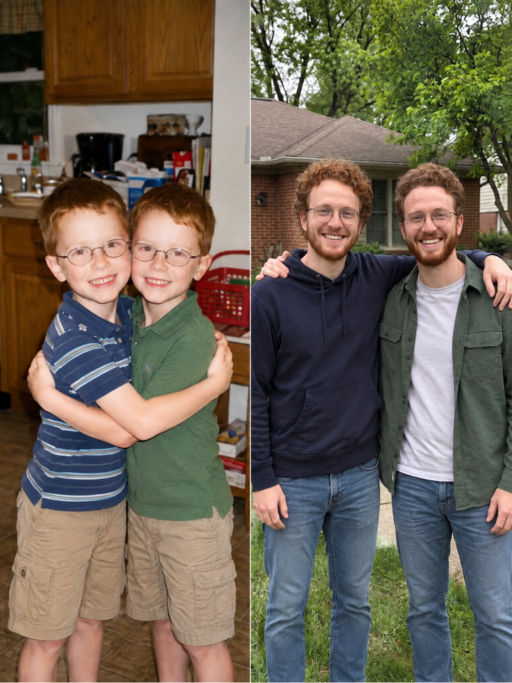
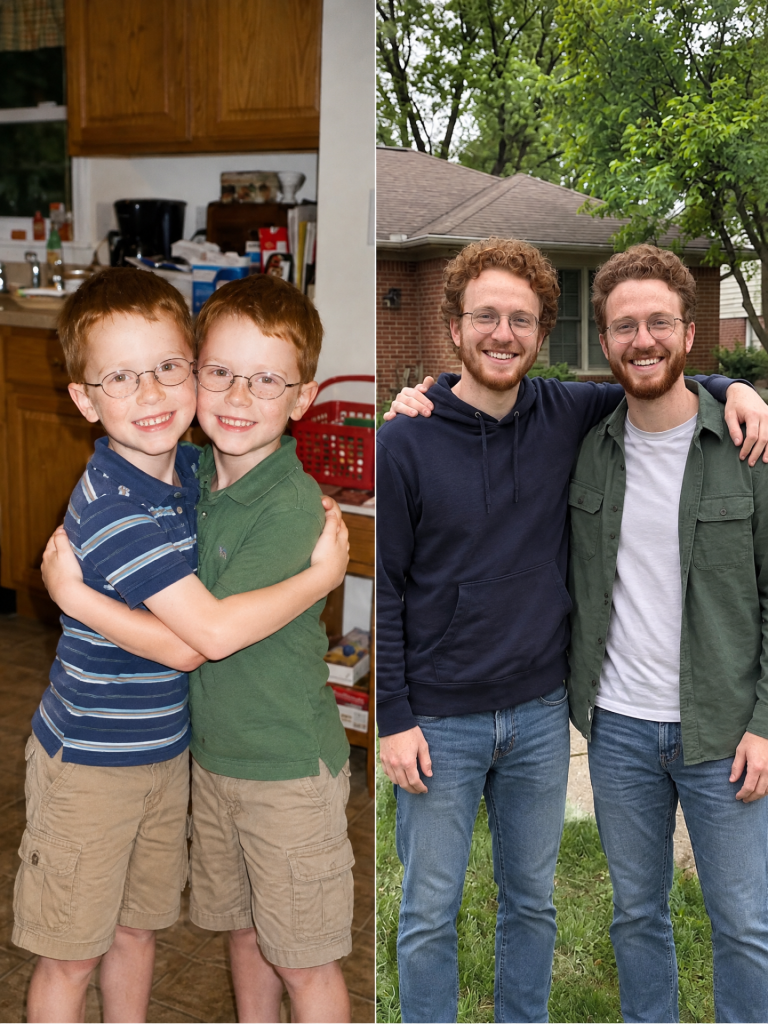
Simon and me.
Laura had dark hair, gentle eyes, and a smile I recognized immediately.
It was Simon’s smile.
On the back, she’d written:
My boys, age three. The happiest part of my life.
Simon touched the photograph with one finger.
Neither of us had ever seen our mother’s face before.
I looked at Beatrice.
“You had this all along, didn’t you? Pictures of her?”
She stared at the floor.
“Yes.”
“And you let us grow up thinking she didn’t love us.”
Her silence was the only answer we needed.
Simon took the photograph from my hands.
“We’re leaving.”
Beatrice looked up.
“After everything I’ve done, you’re just going to walk away?”
I paused at the doorway.
“We’re going to find out what happened to our mother’s inheritance. After that, we’ll decide what place, if any, you have in our lives.”
Outside, Simon leaned against the car, holding the photograph against his chest.
“I spent my whole childhood wondering what was wrong with us,” he whispered.
I stood beside him.
“There was never anything wrong with us.”
The following Monday, we met with an attorney who specialized in estates and trust disputes.
She examined Kenneth’s records and explained that the documents raised serious questions about how our mother’s insurance proceeds had been handled.
But she also warned us that the old statements alone wouldn’t establish the full amount owed.
“We’ll need records from the insurer, the financial institutions, and any guardianship proceedings,” she said.
Then she pointed to a document near the bottom of Kenneth’s folder.
“There’s one more thing I want to investigate.”
It was an account statement dated shortly before Kenneth died.
The balance was substantially larger than Simon and I had expected.
And the account was identified as being held for our benefit.
Our attorney looked up.
“If these funds were preserved and properly administered, there may still be money belonging to both of you.”
For the first time since discovering Beatrice’s lies, we had more than our mother’s letters.
We had a documented financial trail.
And someone who knew how to follow it.
Three weeks after Simon and I discovered our mother’s letters, our attorney called with news that changed everything.
She had obtained records confirming that Kenneth had established an account for our benefit using money from our mother’s insurance proceeds.
And despite everything Beatrice had told us about being financially ruined by raising two children, a substantial portion of that money had been preserved.
“Your uncle was trying to protect your inheritance,” our attorney explained. “He documented the deposits carefully, along with several withdrawals he believed were unauthorized.”
Simon sat beside me in the conference room, staring at the statements.
“Then why didn’t we receive the money when we turned eighteen?”
“That’s one of the questions we’re investigating,” she replied. “The account was never properly transferred to either of you.”
She showed us additional records obtained from the financial institution.
Some transactions matched Kenneth’s handwritten notes.
Others had occurred after his death, when Beatrice had taken control of the household’s financial affairs.
Our attorney explained that determining the exact amount owed would require a formal accounting.
She also advised us to pursue the matter through the appropriate legal channels rather than confronting Beatrice again.
For once, Simon and I agreed without arguing.
We had spent enough years listening to her excuses.
We wanted answers supported by documents.
Over the following months, our attorney worked to obtain the remaining records.
The process was slower than either of us expected.
Some older statements had to be retrieved from archived files, and several transactions required additional documentation.
But gradually, the financial picture became clearer.
Kenneth had preserved money intended for us while we were children.
Beatrice had used other funds associated with our mother’s estate for expenses she could not adequately justify.
And after Kenneth died, she had failed to provide a proper accounting of the money she controlled on our behalf.
Our attorney filed the necessary legal claims.
Beatrice responded through her own lawyer, insisting that every dollar had been spent on raising us.
But the financial records told a more complicated story.
There were ordinary household expenses, certainly.
There were also substantial payments toward Beatrice’s personal debts, improvements to property she owned, and purchases that had no clear connection to our care.
Eventually, the court ordered a formal accounting.
The proceedings did not erase what had happened to us.
They couldn’t give us back the birthdays we spent wondering why our mother hadn’t called.
They couldn’t undo the years Beatrice had made us feel unwanted.
But they established that she had been responsible for money intended for our benefit and had failed to account properly for part of it.
The court ultimately ordered repayment of the amount determined to have been misused, along with applicable interest.
Some of the preserved funds were also released to Simon and me after the necessary account procedures were completed.
We didn’t become millionaires overnight.
We received money that should have been protected for us, and a legal acknowledgment that Beatrice had violated her responsibilities.
For Simon, that acknowledgment mattered more than the amount.
“She spent our entire childhood telling us we owed her everything,” he said after the final hearing. “Now there’s a record showing what she owed us.”
I understood exactly what he meant.
A week later, Beatrice asked to meet with us.
We agreed to speak with her at our attorney’s office.
She looked older than I remembered, with tired eyes and hands that wouldn’t stay still.
For several minutes, she avoided looking directly at either of us.
Finally, she spoke.
“I know you think I never cared about you.”
Simon remained silent.
“I was overwhelmed after Kenneth died,” she continued. “I had two boys to raise, bills to pay, and nobody helping me.”
I looked at her.
“Kenneth died when we were ten. You started lying about our mother long before that.”
She lowered her eyes.
“Yes.”
It was the first time I’d heard her acknowledge the truth without immediately blaming someone else.
“Why did you tell us she abandoned us?” I asked.
Beatrice took a long breath.
“Because Laura was always the person everyone loved. Even when she was sick, everyone worried about her. I was the one taking care of her children, but nobody seemed to notice.”
Simon leaned forward.
“So you made us believe our mother didn’t want us because you resented her?”
Tears filled Beatrice’s eyes.
“I told myself it would be easier for you to believe she had gone away.”
“But you knew it wasn’t true,” I said.
She nodded.
“And when we were old enough to understand, you kept lying.”
“I was afraid you’d hate me.”
I thought about the letters our mother had written from the hospital.
She had asked Beatrice to tell us she loved us.
Instead, Beatrice had spent years convincing us of the opposite.
“You were afraid we’d hate you,” I said quietly, “so you gave us a reason to hate ourselves.”
Beatrice began crying.
For a moment, I felt the familiar urge to comfort her.
I’d spent most of my childhood trying to prevent her from becoming angry or upset.
But I wasn’t that frightened little boy anymore.
“I don’t know whether I’ll ever forgive everything you did,” I told her. “But I won’t carry your lies into the rest of my life.”
Simon stood beside me.
“We don’t want any further contact right now.”
Beatrice nodded through her tears.
Neither of us waited for another explanation.
We walked out together.
Several months later, Simon and I visited the hospice organization where our mother had received care.
Grandma Rose accompanied us.
She had brought another photograph of Laura, taken shortly before her illness became severe.
In it, our mother was sitting on a garden bench with both of us on her lap.
She looked tired but happy.
Grandma traced the edge of the photograph.
“She talked about you boys constantly,” she said. “Even on the days she was exhausted, she wanted to know what you’d eaten, whether you were sleeping well, and if you were getting along.”
I smiled through tears.
“That sounds like a mother.”
“She was a wonderful one.”
Simon and I decided to donate part of the money we’d recovered to support families facing serious illness.
We also set aside funds for our own futures, just as Kenneth had intended.
But the most valuable thing we received wasn’t financial.
It was the truth about Laura.
For twenty years, I’d pictured a woman walking away from two little boys at a bus station without looking back.
That image had followed me through childhood, college, and adulthood.
Now I knew it had never happened.
Our mother had been ill.
She had trusted her sister to care for us temporarily.
She had written letters, planned for our future, and hoped to return home.
Her life ended before she could raise us, but she had never chosen to abandon us.
One evening, Simon called while I was sitting at my kitchen table with her photograph beside me.
“Do you ever wonder what she’d think of us now?” he asked.
“All the time.”
“Do you think she’d be proud?”
I looked at the picture of the young woman holding her twin sons.
“I think she’d be glad we found each other again.”
Simon laughed softly.
“We never really lost each other.”
“No,” I said. “But we almost let Beatrice’s lies decide who we were.”
After we hung up, I unfolded the letter our mother had addressed to her beautiful boys.
The paper was fragile, and the ink had faded in places.
But her final words were still clear.
Being apart doesn’t mean I love you any less.
For most of my life, I had believed I was a child someone didn’t want.
Now, at twenty-three, I finally understood that I had been loved from the very beginning.
And that was the inheritance nobody could ever take from us.