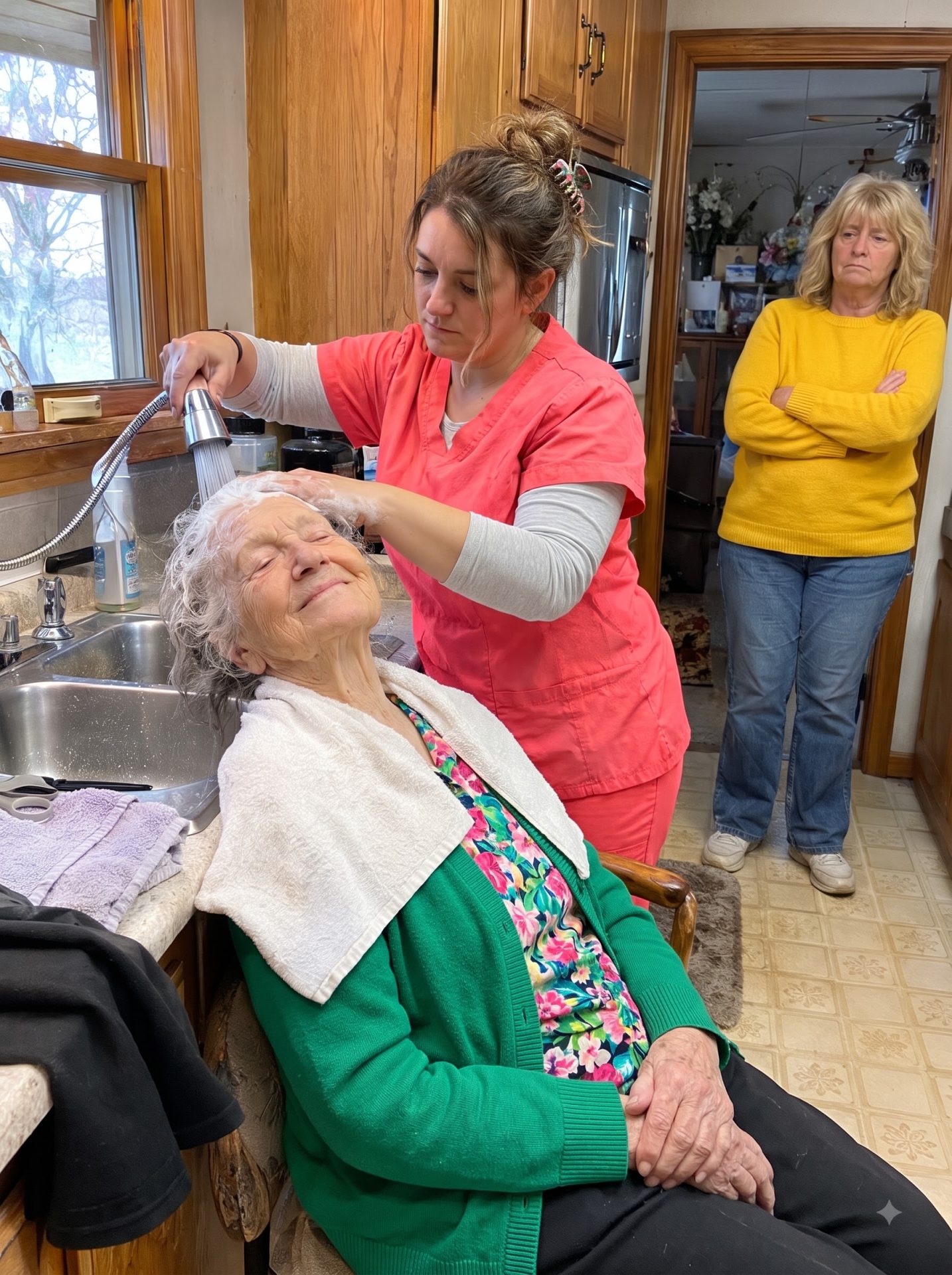

On the first Monday of November, I found my ninety-one-year-old grandmother-in-law sitting alone in a back bedroom, pressing one hand against her head as though she were desperately trying to hide something. When I stepped closer, I discovered that the woman who had spent forty years making other people beautiful had become too ashamed to let anyone see her.
My name is Nicole, although Grandma Lorraine had affectionately called me Nicky since I married her grandson Joel seven years earlier. I owned a hair salon in Viroqua, Wisconsin, and had spent thirteen years working as a hairstylist.
That afternoon, I had driven to my mother-in-law Darla’s house with cinnamon bread from the bakery beside my shop. Darla’s car was outside, but nobody answered the door, so I entered through the kitchen as I had done countless times before.
The television was playing in an empty living room, and I found Grandma’s bedroom door closed. When I knocked, she told me not to enter, but the distress in her voice made me open it slightly.
“Don’t look at me, Nicole.”
She was sitting in an old green recliner with a blanket covering her legs and a soft brace supporting her injured left wrist. Her normally immaculate white hair was flattened, tangled, and greasy, with a large knot behind her ear and irritated patches along her scalp.
For sixty years, Lorraine had carefully arranged her hair into perfect pin curls every Saturday evening. Seeing her in such a condition frightened me because I recognized the signs of someone who hadn’t received proper hair care for months.
Grandma Lorraine was born near Viroqua in 1934 and married Walter Pederson in 1953. Together they raised two sons, including Joel’s father, Ron, and built a life deeply connected to their small Wisconsin community.
For forty years, she operated Lorraine’s Beauty Nook on Main Street, serving generations of local women. Brides, widows, farm wives, and teenagers preparing for dances trusted her with their hair and often their most personal worries.
She closed the salon in 1998 when Walter became ill, and the building remained empty until I purchased it in 2016. I was twenty-two, newly qualified as a cosmetologist, and unaware that my new business had once belonged to the woman who would eventually become my grandmother-in-law.
Lorraine walked into the salon before I had even installed my sign. She inspected the old checkered floor, sat in my chair, and corrected nearly every step of my first attempt to style her hair.
“You’re using too much setting lotion, honey. You’re not glazing a ham.”
Despite her criticism, she approved my work and booked another appointment for the following Saturday at two o’clock. She returned every week for three years, teaching me techniques and lessons about caring for clients that no cosmetology school had ever explained.
Eventually, she introduced me to Joel, and we married two years later. She became my mentor, family, and one of the most important women in my life.
Now, sitting in Darla’s back bedroom, she couldn’t even raise her arms to wash her own hair. When I gently asked what had happened, she turned toward the window and whispered that she was simply tired.
But I knew there was much more to the story.
Grandma Lorraine’s difficulties began in July when she fell while hanging laundry outside her longtime home on Jefferson Street. She fractured her left wrist in two places and spent four days in the hospital followed by three weeks in rehabilitation.
Her doctors concluded that she could no longer safely live alone, at least until her balance and mobility improved. Joel and I offered our spare bedroom, but our apartment above my salon had steep stairs that made it unsuitable.
Instead, Lorraine moved into the ranch-style home belonging to Darla, Joel’s sixty-two-year-old mother. Darla worked part-time at Kwik Trip, maintained a tidy household, and had spent decades enduring criticism from her mother-in-law.
Lorraine had repeatedly complained about Darla’s cooking, housekeeping, and appearance, sometimes embarrassing her during family gatherings. Their relationship had remained strained for forty years, although nobody openly discussed what had originally caused the hostility.
In August, Darla became Lorraine’s Social Security representative payee, taking responsibility for managing her monthly benefits. Grandma received $1,640, of which Darla allocated $1,200 toward room, board, and care, leaving $440 for other expenses.
I initially wondered whether the arrangement was fair, but I knew that providing meals, shelter, utilities, and daily assistance carried substantial costs. What troubled me more was discovering how badly Grandma’s personal grooming had deteriorated.
When I asked when she had last washed her hair, she admitted that she hadn’t managed it since September. Her injured wrist prevented her from raising both arms, and bending over a sink made her dizzy.
“Did you ask Darla to help you?”
“I’m not asking that woman to wash my hair.”
Grandma feared that Darla would pull too hard, complain, or make her feel helpless. More importantly, she couldn’t bear the humiliation of depending on someone she had criticized for decades.
She also admitted that she had stopped attending Viroqua Lutheran Church seven weeks earlier. She had worshipped there since childhood, married Walter there, and attended his funeral in the same sanctuary.
“I can’t go to church looking like this, Nicky.”
After speaking with Grandma, I found Darla preparing chili in the kitchen. When I asked about Lorraine’s hair, she admitted that it hadn’t been washed since August because Grandma repeatedly refused her offers of help.
“She won’t let me near her head, Nicole. And I’m not her maid.”
I wanted to confront Darla, but then I noticed the organized medications, medical appointments, folded laundry, and nutritional supplements scattered around the kitchen. The exhaustion beneath her eyes suggested that she was managing far more responsibilities than anyone appreciated.
That evening, I told Joel everything, and he immediately wanted to confront his mother. I stopped him because I feared another argument would only deepen the conflict without helping Grandma.
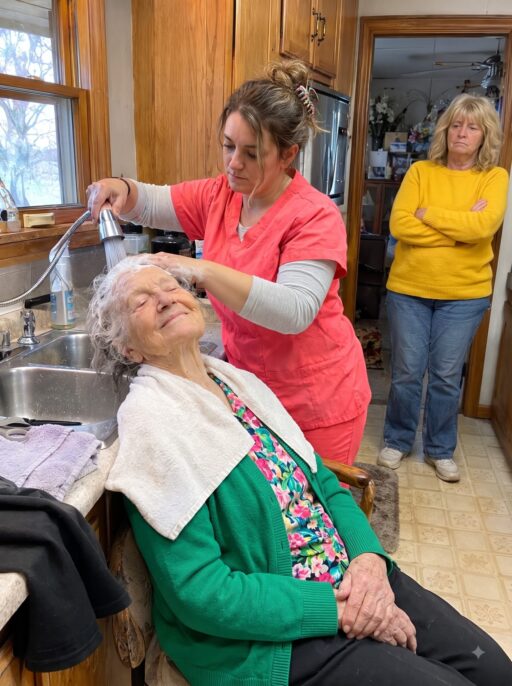
Instead, I called Lorraine the following evening and offered her an appointment.
“A wash and set, Saturday at two. I’ll bring everything to Darla’s house.”
“I’m not a charity case.”
“No, ma’am. You’re my two o’clock appointment.”