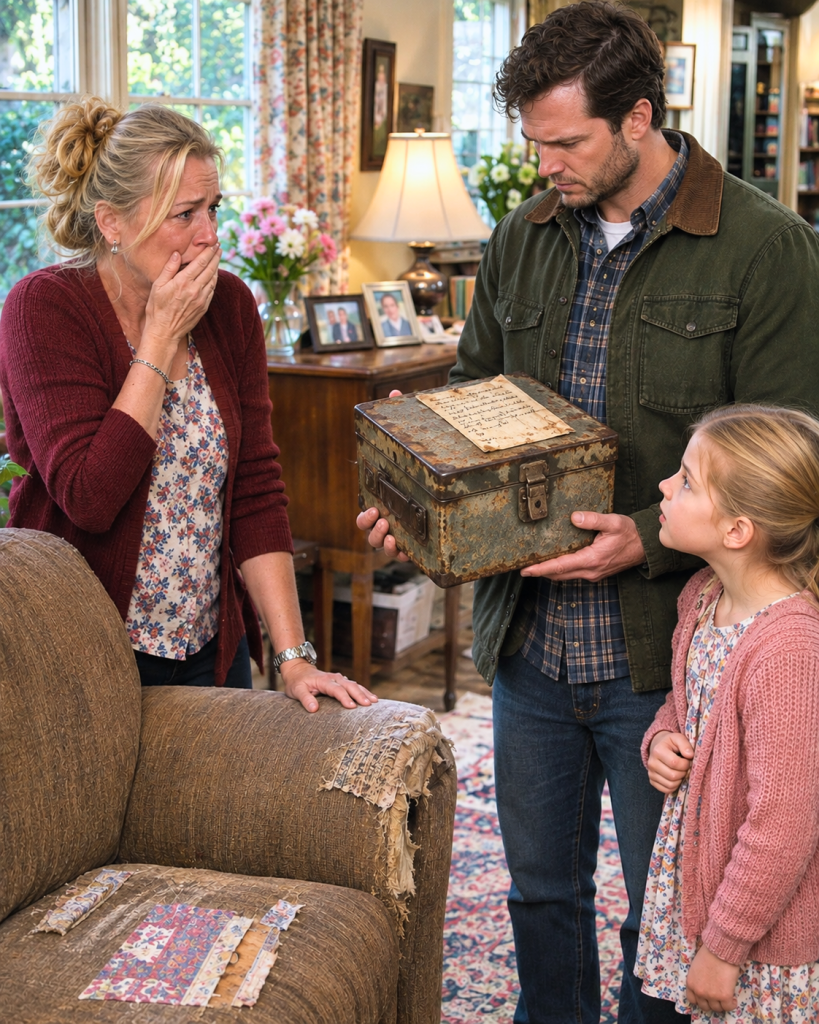

“Ma’am, did your husband have two daughters?”
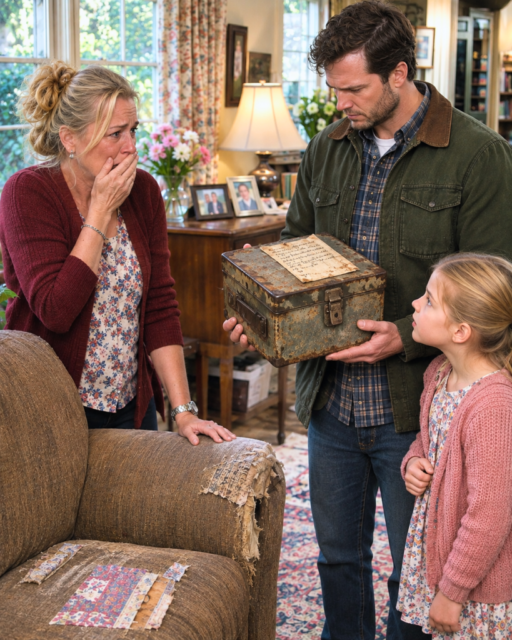
The young man who had purchased my late husband’s old recliner stood on my porch, holding a scratched metal box. When I recognized my husband’s handwriting on the lid, my hands began trembling.
One of our daughters had been dead for nearly thirty years.
“Where did you find that?”
“Inside the chair. I thought you should see it.”
My name is Margaret Dawson. I was sixty-three, a retired elementary school secretary living in Pittsburgh, Pennsylvania. Seven months earlier, I’d lost Walter, my husband of thirty-eight years.
Walter had been a carpenter who believed that anything broken could be repaired. For more than twenty years, I’d begged him to replace his ugly brown recliner, with its worn upholstery and stubborn reclining mechanism.
“Walter, we can afford a new chair.”
“There’s nothing wrong with this one that a little patience can’t fix.”
After he died, that ridiculous chair became my favorite place in the house. Every evening, I curled up beneath his old knitted sweater, watching television until I fell asleep.
My twenty-eight-year-old daughter, Claire, eventually expressed her concern.
“Mom, you haven’t slept properly in months. Dad wouldn’t want you living like this.”
I knew she was right, although accepting her advice felt like admitting Walter wasn’t coming home.
That evening, I photographed the recliner and listed it online for fifty dollars.
The following afternoon, a thirty-two-year-old man named Ethan Miller arrived with his six-year-old daughter, Sophie. While he examined the reclining mechanism, Sophie climbed onto the seat and smiled.
“Daddy, we can read bedtime stories here!”
Ethan explained that he’d recently divorced and was furnishing a small apartment. He wanted somewhere comfortable to sit with his daughter during the weekends she spent with him.
When he handed me fifty dollars, I returned half.
“Buy your little girl some books.”
He thanked me, and I watched as he loaded the chair into his pickup truck. For a moment, I wanted to run outside and ask him to bring it back.
Instead, I closed the front door.
That night, I slept in my bedroom for the first time in weeks.
Then Ethan returned the following morning.
Sitting across from me at the kitchen table, he explained that Sophie had dropped a colored pencil between the cushions. While searching for it, he’d discovered an unusual section of fabric beneath the chair that appeared to have been stitched closed by hand.
“I thought something might have fallen inside years ago. But someone had secured this box to the wooden frame.”
He placed it before me.
“I opened it because I was trying to identify the owner. I’m sorry if I saw something private.”
I recognized the metal box immediately. Walter had once used it to store screws and small woodworking tools.
I thanked Ethan and assured him that Sophie could keep the chair.
After he left, I slowly lifted the lid.
Inside were dozens of envelopes, carefully arranged and labeled with dates. The first contained a birthday card decorated with delicate pink flowers.
I opened it.
Happy 30th birthday, Abigail.
Beneath those words was a handwritten message from Walter.
Our first daughter, Abigail, had died when she was only nine months old.
Yet the card described the woman she might have become, the birthday dinner we might have shared, and the grandchildren Walter sometimes imagined holding.
I looked at the remaining envelopes.
Each carried a different year.
My husband had apparently been celebrating our daughter’s birthdays in secret for three decades, while I had spent those same years trying not to remember them.
I carried the metal box into the living room and began arranging the envelopes according to their dates. Some were yellowed with age, while others looked as though Walter had purchased them only months before his death.
The oldest contained a birthday card featuring a cartoon rabbit.
Happy first birthday, Abigail.
Walter had written about the cake we might have bought and how he imagined our daughter making a mess with the frosting.
I remembered that particular birthday. I’d spent most of the afternoon in our bedroom, refusing to answer the telephone, while Walter quietly prepared dinner downstairs.
Neither of us had mentioned Abigail’s name.
Apparently, he had found another way to acknowledge the occasion.
I opened the card for her fifth birthday.
Walter imagined walking Abigail to kindergarten, carrying her little backpack because she insisted it was too heavy. He described me standing outside the classroom, pretending not to cry.
For her sixteenth birthday, he wrote about teaching her to drive.
Your mother would probably be a better instructor. I still haven’t recovered from teaching her how to reverse into our driveway.
Despite myself, I laughed.
Walter had always teased me about my driving.
As I continued reading, I realized that he’d given Abigail a personality assembled from little pieces of both of us. She was stubborn, impatient, affectionate, and occasionally terrible at following instructions.
He hadn’t imagined a perfect daughter. He’d imagined an ordinary one.
Then I opened a card written when Abigail would have turned ten.
The first few paragraphs described a family vacation Walter wished we could have taken together. But near the bottom, the handwriting became smaller.
Your little sister asked me something difficult today. She wanted to know whether Mommy and I loved her as much as we loved you.
I stopped reading.
Claire would have been eight years old.
I told her that loving one daughter doesn’t mean loving the other any less. I’m not sure she believed me.
I searched my memory, trying to recall anything unusual about that year.
Claire had been an excellent student who rarely caused trouble. Her teachers described her as considerate, responsible, and unusually concerned about disappointing adults.
I’d always considered those qualities evidence that Walter and I were raising her well.
Now I wondered whether there had been another explanation.
I continued searching through the box until I discovered an old photograph tucked inside an envelope.
It showed Claire standing between Walter and me outside our house. She was holding a school certificate, smiling proudly.
I remembered displaying that certificate on our refrigerator.
On the back, Walter had written the date and several sentences.
Claire asked whether Abigail would have been better at school than she was. I told her that nobody could possibly know.
Beneath that was another note.