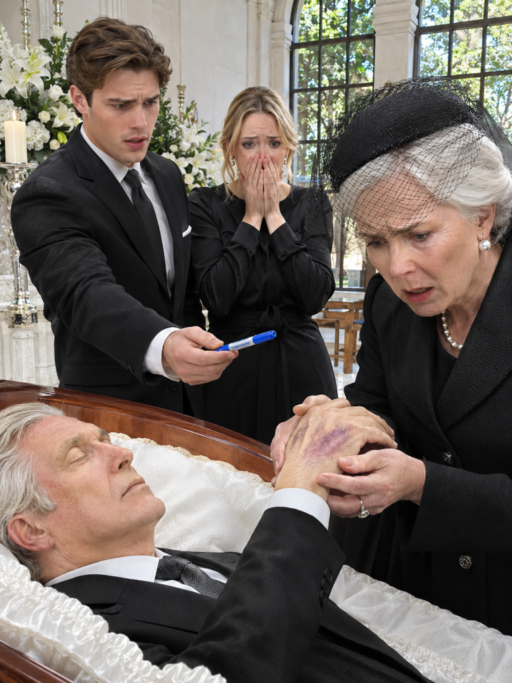
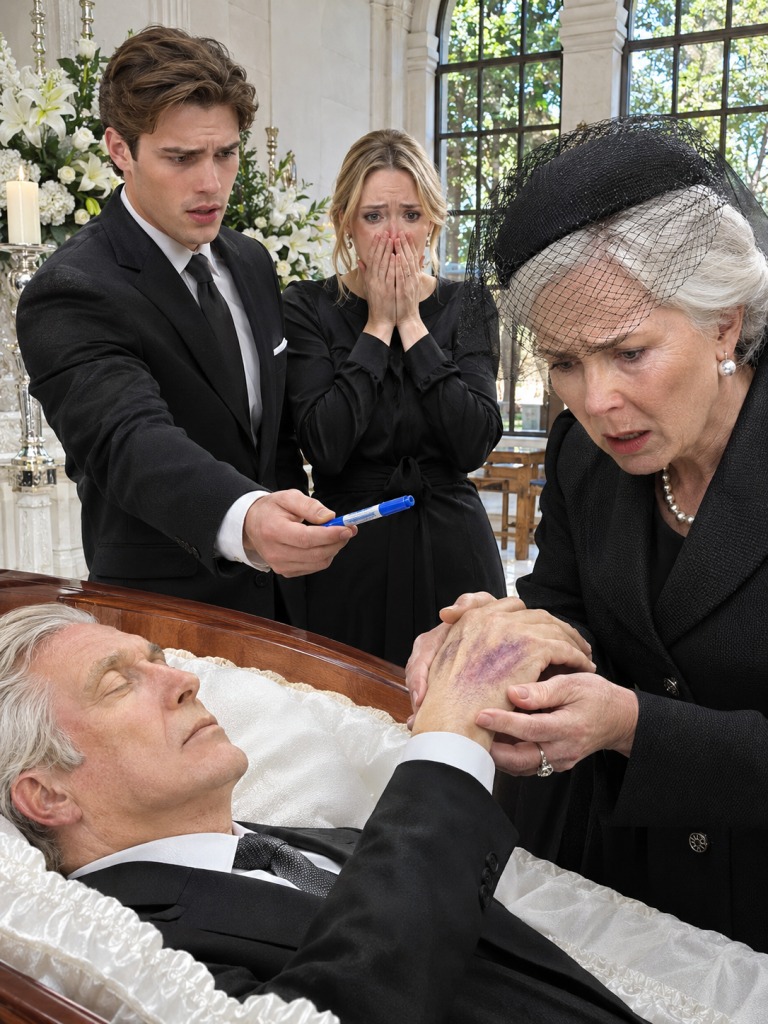

“Stop! Nobody is cremating my husband until I see his left hand! Open that casket immediately!”
My voice echoed throughout the funeral home as two employees prepared to remove Walter’s coffin. My son, Ryan, stared at me in embarrassment, while his wife, Brenna, hurried forward and grabbed my arm.
“Mom, have you completely lost your mind? Everyone is watching! Please let Dad rest in peace!”
I refused to move because forty minutes earlier, I had received a disturbing phone call from an unidentified man. His trembling voice had delivered a warning that I couldn’t possibly ignore.
“Mrs. Hendricks, please examine your husband’s left hand before they cremate him. You need to see it before it’s too late.”
The stranger disconnected before I could ask his name or demand an explanation.
My name is Carol Hendricks, and at sixty-four, I had just lost the man with whom I had shared forty years of marriage. Walter and I had built a modest diner near the farmers’ market in Lancaster, Pennsylvania, serving homemade beef stew and freshly baked cornbread.
After decades of hard work, we had saved enough money to purchase a four-story commercial building that generated rental income. We weren’t particularly wealthy, but we had created a comfortable life through patience, sacrifice, and determination.
Our only son, Ryan, his wife, Brenna, and their nine-year-old son, Eli, had been living with us for two years. Brenna frequently helped manage our finances, organized rental payments, and accompanied me to medical appointments.
Walter considered her a blessing to our family, and until that terrible October morning, I had felt exactly the same way.
I was visiting my sister Irene in Harrisburg when Walter called me around ten that evening. Ryan was working overnight at a distribution center, leaving Brenna and Eli at home with my husband.
“Carol, I need you to come home early tomorrow. I’ve discovered something we need to discuss.”
“What’s wrong, old man? Are you feeling alright?”
“I can’t explain everything over the phone. We’ll talk when you get home.”
His troubled voice concerned me, but I assumed the matter could wait until morning. Before going to sleep, I silenced my phone to avoid disturbing my sister.
At six-thirty the following morning, Brenna called me in tears.
“Mom, Dad’s gone! I found him in bed, and he wasn’t breathing!”
By the time I returned to Lancaster, Walter’s body had already been transferred to the funeral home. Brenna claimed he had suffered a fatal heart attack during the night, an explanation everyone accepted because of his previous cardiac problems.
However, she repeatedly pressured me to arrange an immediate cremation, despite knowing that Walter wished to be buried beside his parents in Columbia. Her insistence made me uncomfortable, but grief had left me too exhausted to argue.
Three days later, the anonymous caller gave me a reason to question everything. Standing beside Walter’s coffin, I demanded that the funeral director remove the lid.
My husband was wearing the navy suit he had purchased for Ryan’s wedding. With trembling fingers, I carefully lifted the white cloth covering his left hand and discovered a small puncture mark surrounded by a dark bruise.
“Ryan, look at this! Your father died at home. Who gave him an injection?”
My son stared at the mark in disbelief, but Brenna’s reaction frightened me even more. Her face turned deathly pale as she reached forward and desperately attempted to cover Walter’s hand again.
At that moment, I realized my husband’s death might not have been natural at all.
“Nobody touches my husband until the police arrive!”
Brenna immediately burst into tears, insisting before our relatives that grief had caused me to lose my judgment. Ryan attempted to calm me down, but I refused to leave Walter’s side until the authorities suspended the cremation and ordered an autopsy.
Several days later, I discovered that the anonymous caller was Rodney Pratt, an employee responsible for preparing bodies at the funeral home. He had noticed the suspicious mark on Walter’s hand and questioned Brenna about it.
“She claimed it was from an injection administered at the hospital. But your husband’s paperwork clearly stated that he died at home.”
Rodney also revealed that Brenna had offered him an envelope containing cash, encouraging him to complete the preparations quickly. His suspicions had grown so strong that he eventually decided to contact me.
When I returned home, I remembered something that made me increasingly uneasy. As a diabetic, I regularly used insulin pens and had purchased three new ones approximately a week before Walter’s death.
I opened the refrigerator and discovered that only two remained. Despite searching through my medical supplies and kitchen drawers, I couldn’t locate the missing pen.
Although I had no evidence connecting its disappearance to Walter’s death, I couldn’t dismiss the possibility. I decided to keep my suspicions to myself until I learned more.
A week later, one of our commercial tenants contacted me with an unexpected question.
“Mrs. Hendricks, are you planning to sell the building? An appraiser came here last month and photographed the property.”
I immediately examined our financial documents and discovered that Walter had unknowingly secured a loan of nearly $400,000 against our commercial building three weeks before his death. The lender’s records listed Brenna’s telephone number as the primary contact.
After obtaining the relevant bank statements through the estate process, I discovered that the entire loan amount had been transferred from Walter’s account to Brenna on the same day. I suddenly remembered a conversation with my husband during Eli’s birthday celebration.
“Brenna asked me to sign some paperwork for the fire insurance. There were so many pages that I barely understood any of it.”
Additional notes I discovered at our diner suggested Walter had uncovered the deception shortly before he died. His distressed telephone call suddenly made considerably more sense.
That evening, Brenna prepared my favorite dinner and placed several documents before me.
“Mom, we should transfer the building into Ryan’s name. Your signature would make settling the estate much easier.”