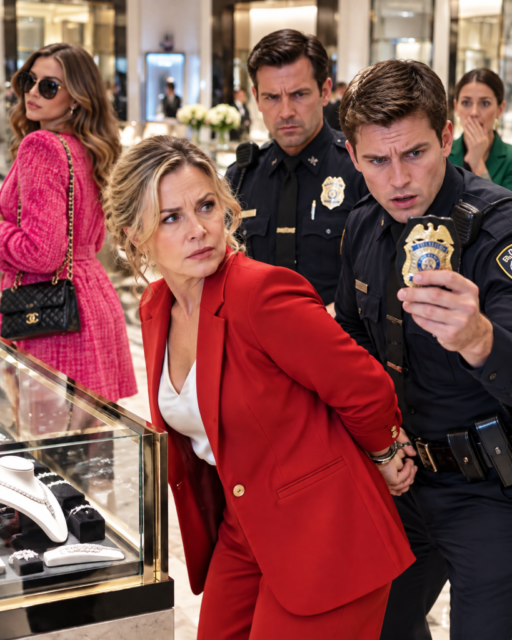
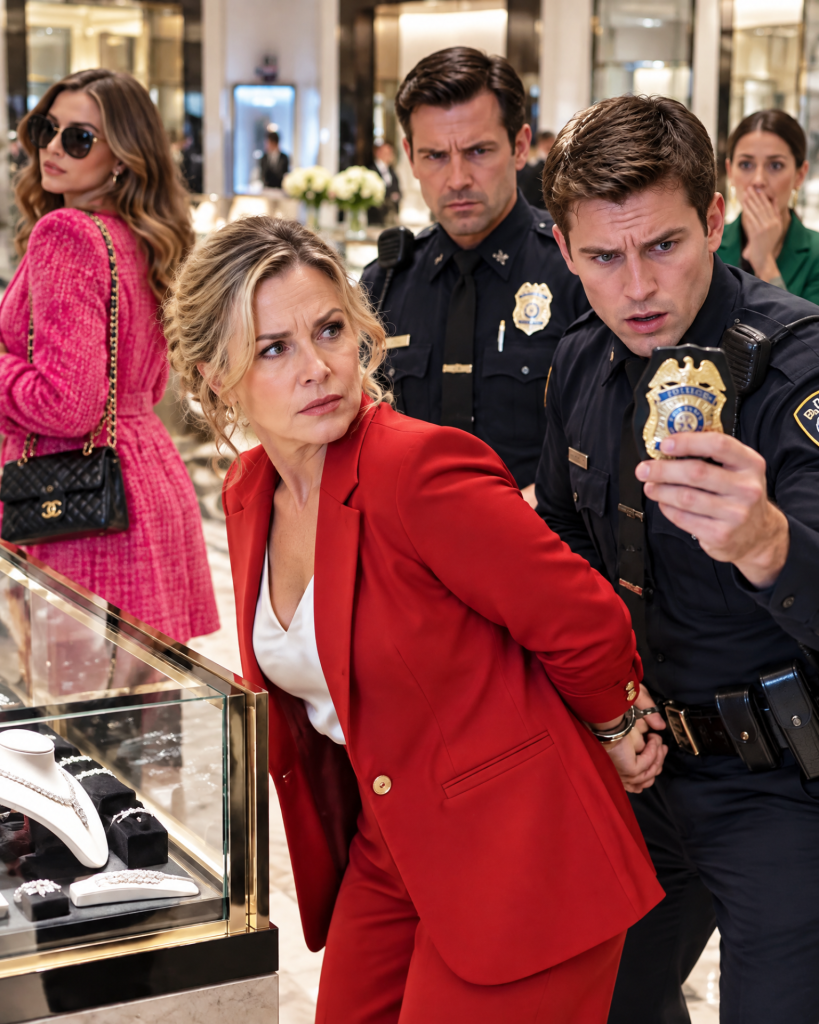

“I thought this was a normal detention,” he said quietly. “Renee told us the sales associate identified her.”
“The associate never identified me,” I said. “Ask her.”
The security-room door opened slightly.
A young woman stood outside, pale and shaking. It was the sales associate I had spoken to by the display case. Her name tag read Tessa.
“I told them it was the woman in the cream coat,” she whispered.
Renee turned sharply. “You need to leave.”
Tessa did not move.
“I told you exactly what I saw,” she continued. “You said that customer’s family has investments here and that I should keep my job if I knew what was good for me.”
For the first time, Kyle looked openly disturbed.
Holloway grabbed the door and shut it in Tessa’s face. “This conversation is over.”
“No,” I said. “It is only beginning.”
A moment later, heavy footsteps sounded in the corridor. Holloway reached toward his radio, but the door opened before he could speak.
Three state investigators entered with their director, Marcus Bell, at the front.
Marcus had worked with me years earlier on a regional corruption task force. His eyes went first to my badge in Kyle’s hand, then to the surveillance console, then to the officers surrounding me.
“Dana,” he said. “Are you all right?”
“I am now.”
Renee forced a smile. “Director Bell, this is an internal store-security issue. There has been confusion about a theft report.”
Marcus looked at the technician.
“Has any footage been altered?”
The technician swallowed hard.
Renee’s smile disappeared.
Before he could answer, Tessa pushed the door open again. This time, she held up her phone.
“I recorded what happened,” she said.
Renee lunged toward her.
State investigators moved instantly, blocking her path.
Tessa’s hands trembled as she pressed play. On her screen, the surveillance monitors were visible, including the woman in the cream coat placing the bracelet into her handbag.
Then Renee’s voice filled the room.
Delete it before anyone sees.
Marcus Bell looked at Holloway.
And the officer who had told me no one would believe me suddenly had nowhere left to hide.
Marcus ordered every person in the surveillance room to remain where they were.
Renee was escorted to a chair near the wall, while Officer Holloway and Officer Benton surrendered their radios and weapons to the state investigators. Tessa stood beside me, clutching her phone with both hands, and I could see how close she was to crying.
“You did the right thing,” I told her.
Marcus asked the technician to preserve the store’s entire surveillance system, not just the jewelry-counter footage. When the technician explained that Renee had attempted to erase a portion of the recording, investigators immediately secured the console and requested a digital-forensics team.
Renee still tried to control the story.
“This is a misunderstanding,” she said. “The woman in the cream coat is an important client. We were trying to avoid embarrassing her over an allegation.”
“She was seen on video taking a bracelet,” Marcus replied. “And you instructed officers to detain the person who reported it.”
Renee looked toward Holloway.
He did not defend her.
That was when the first crack appeared.
Benton admitted he had been told to rely on Renee’s identification because she had worked with the department before. Holloway remained silent until investigators showed him Tessa’s video, which included his threat to me and Renee’s order to remove the footage.
Then he asked for an attorney.
The deeper investigation began the following morning.
Search warrants uncovered internal reports that did not match the store’s inventory records. Over three years, valuable items had been marked as recovered after supposed thefts, but many of those “recoveries” were tied to customers who had never been charged.
Instead, innocent people had been accused.
Renee had built a system around wealthy shoppers who were allowed to leave with expensive merchandise. When numbers no longer matched, store security chose someone else to blame—a customer who appeared isolated, uncertain, or unable to afford a lengthy legal defense.
The officers involved helped make those false cases look credible.
One of the files belonged to a young nursing student named Kayla Monroe.
Two years earlier, Kayla had been detained after a store employee claimed she stole a designer handbag. She insisted she had never even entered that department, but the report, witness statement, and missing camera footage all seemed to prove otherwise.
Now investigators found the same signature patterns in her case.
The same manager.
The same officer.
The same unexplained deletion from the surveillance system.
When Kayla came to the state office to learn her case was being reopened, she stood in the lobby with both hands pressed over her mouth.
“I thought no one believed me,” she said.
Marcus looked at me, then at Tessa.
“People believed you,” he said. “They just had more power.”
The woman in the cream coat was arrested later that evening at her family’s estate. Her name was Claire Duvall, and her relatives had commercial contracts with the department store worth millions.
But Claire was not the worst part of the story.
The worst part was the list investigators found in Renee’s private files: dozens of names, dates, and product values, each linked to someone who had been chosen to carry blame for a theft they did not commit.
Marcus handed me the list.
At the bottom of the final page was a note written in Renee’s handwriting:
Next review meeting: select replacements for the pending losses.
There were three names beneath it.
And one of them belonged to Tessa.